Saturday, 18 February 2017

John Adams

9. John Adams

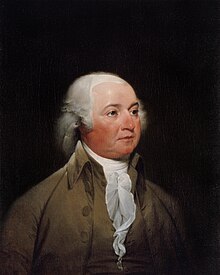
Official Presidential portrait of John Adams (by John Trumbull, circa 1792).jpg


John Adams (October 30 [O.S. October 19] 1735 – July 4, 1826) was an American patriot who served as the second President of the United States (1797–1801) and the first Vice President (1789–97).[1] He was a lawyer, diplomat, statesman, political theorist, and, as a Founding Father, a leader of the movement for American independence from Great Britain.[2] He was also a dedicated diarist and correspondent, particularly with his wife and closest advisor Abigail.

He collaborated with his cousin, revolutionary leader Samuel Adams, but he established his own prominence prior to the American Revolution. After the Boston Massacre, he provided a successful (though unpopular) legal defense of the accused British soldiers, in the face of severe local anti-British sentiment and driven by his devotion to the right to counsel and the "protect[ion] of innocence".[3] Adams was a delegate from Massachusetts to the Continental Congress, where he played a leading role in persuading Congress to declare independence. He assisted Thomas Jefferson in drafting the Declaration of Independence in 1776, and was its foremost advocate in the Congress. As a diplomat in Europe, he helped negotiate the eventual peace treaty with Great Britain, and acquired vital governmental loans from Amsterdam bankers. Adams was the primary author of the Massachusetts Constitution in 1780 which influenced American political theory, as did his earlier Thoughts on Government (1776).

Adams's credentials as a revolutionary secured for him two terms as President George Washington's vice president (1789 to 1797) and also his own election in 1796 as the second president. In his single term as president, he encountered fierce criticism from the Jeffersonian Republicans, as well as the dominant faction in his own Federalist Party, led by his rival Alexander Hamilton. Adams signed the controversial Alien and Sedition Acts, and built up the army and navy in the face of an undeclared naval "Quasi-War" with France. The major accomplishment of his presidency was a peaceful resolution of the conflict in the face of Hamilton's opposition. Due to his strong posture on defense, Adams is "often called the father of the American Navy".[4] He was the first U.S. president to reside in the executive mansion, now known as the White House.[5]

In 1800, Adams lost re-election to Thomas Jefferson and retired to Massachusetts. He eventually resumed his friendship with Jefferson upon the latter's own retirement by initiating a correspondence which lasted fourteen years.[6] He and his wife established a family of politicians, diplomats, and historians now referred to as the Adams political family. Adams was the father of John Quincy Adams, the sixth President of the United States. He died on the fiftieth anniversary of the adoption of the Declaration of Independence, and the same day as Jefferson. Modern historians in the aggregate have favorably ranked his administration.

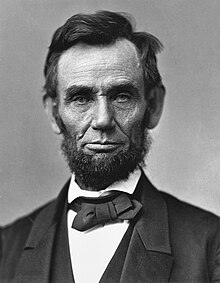
Abraham Lincoln

8. Abraham Lincoln

An iconic photograph of a bearded Abraham Lincoln showing his head and shoulders.

Abraham Lincoln (Listeni/ˈeɪbrəhæm ˈlɪŋkən/; February 12, 1809 – April 15, 1865) was an American politician and lawyer who served as the 16th President of the United States from March 1861 until his assassination in April 1865. Lincoln led the United States through its Civil War—its bloodiest war and perhaps its greatest moral, constitutional, and political crisis.[2][3] In doing so, he preserved the Union, abolished slavery, strengthened the federal government, and modernized the economy.

Born in Hodgenville, Kentucky, Lincoln grew up on the western frontier in Kentucky and Indiana. Largely self-educated, he became a lawyer in Illinois, a Whig Party leader, and was elected to the Illinois House of Representatives, in which he served for eight years. Elected to the United States House of Representatives in 1846, Lincoln promoted rapid modernization of the economy through banks, tariffs, and railroads. Because he had originally agreed not to run for a second term in Congress, and because his opposition to the Mexican–American War was unpopular among Illinois voters, Lincoln returned to Springfield and resumed his successful law practice. Reentering politics in 1854, he became a leader in building the new Republican Party, which had a statewide majority in Illinois. In 1858, while taking part in a series of highly publicized debates with his opponent and rival, Democrat Stephen A. Douglas, Lincoln spoke out against the expansion of slavery, but lost the U.S. Senate race to Douglas.

In 1860, Lincoln secured the Republican Party presidential nomination as a moderate from a swing state. Though he gained very little support in the slaveholding states of the South, he swept the North and was elected president in 1860. Lincoln's victory prompted seven southern slave states to form the Confederate States of America before he moved into the White House - no compromise or reconciliation was found regarding slavery and secession. Subsequently, on April 12, 1861, a Confederate attack on Fort Sumter inspired the North to enthusiastically rally behind the Union. As the leader of the moderate faction of the Republican Party, Lincoln confronted Radical Republicans, who demanded harsher treatment of the South, War Democrats, who called for more compromise, anti-war Democrats (called Copperheads), who despised him, and irreconcilable secessionists, who plotted his assassination. Politically, Lincoln fought back by pitting his opponents against each other, by carefully planned political patronage, and by appealing to the American people with his powers of oratory.[4] His Gettysburg Address became an iconic endorsement of the principles of nationalism, republicanism, equal rights, liberty, and democracy.

Lincoln initially concentrated on the military and political dimensions of the war. His primary goal was to reunite the nation. He suspended habeas corpus, leading to the controversial ex parte Merryman decision, and he averted potential British intervention in the war by defusing the Trent Affair in late 1861. Lincoln closely supervised the war effort, especially the selection of top generals, including his most successful general, Ulysses S. Grant. He also made major decisions on Union war strategy, including a naval blockade that shut down the South's normal trade, moves to take control of Kentucky and Tennessee, and using gunboats to gain control of the southern river system. Lincoln tried repeatedly to capture the Confederate capital at Richmond; each time a general failed, Lincoln substituted another, until finally Grant succeeded. As the war progressed, his complex moves toward ending slavery included the Emancipation Proclamation of 1863; Lincoln used the U.S. Army to protect escaped slaves, encouraged the border states to outlaw slavery, and pushed through Congress the Thirteenth Amendment to the United States Constitution, which permanently outlawed slavery.

An exceptionally astute politician deeply involved with power issues in each state, Lincoln reached out to the War Democrats and managed his own re-election campaign in the 1864 presidential election. Anticipating the war's conclusion, Lincoln pushed a moderate view of Reconstruction, seeking to reunite the nation speedily through a policy of generous reconciliation in the face of lingering and bitter divisiveness. On April 14, 1865, five days after the surrender of Confederate commanding general Robert E. Lee, Lincoln was assassinated by John Wilkes Booth, a Confederate sympathizer.

Lincoln has been consistently ranked both by scholars[5] and the public[6] as among the greatest U.S. presidents.


Lyndon B. Johnson

7. Lyndon B. Johnson

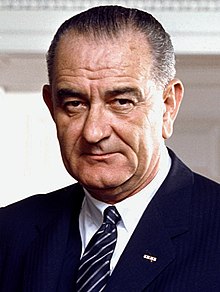
37 Lyndon Johnson 3x4.jpg

Lyndon Baines Johnson (/ˈlɪndən ˈbeɪnz ˈdʒɒnsən/; August 27, 1908 – January 22, 1973), often referred to as LBJ, was an American politician who served as the 36th President of the United States from 1963 to 1969, assuming the office after serving as the 37th Vice President of the United States under President John F. Kennedy, from 1961 to 1963. Johnson was a Democrat from Texas, who served as a United States Representative from 1937 to 1949 and as a United States Senator from 1949 to 1961. He spent six years as Senate Majority Leader, two as Senate Minority Leader, and two as Senate Majority Whip.

Johnson ran for the Democratic nomination in the 1960 presidential election. Although unsuccessful, he was chosen by Senator John F. Kennedy of Massachusetts to be his running mate. They went on to win a close election over Richard Nixon and Henry Cabot Lodge. Johnson was sworn in as Vice President on January 20, 1961. Two years and ten months later, on November 22, 1963, Johnson succeeded Kennedy as President following the latter's assassination. He ran for a full term in the 1964 election, winning by a landslide over Republican opponent Arizona Senator Barry Goldwater. He is one of only four people[a] who have served as President, Vice President, Senator, and Representative.[1] Johnson was renowned for his domineering, sometimes abrasive, personality, and the "Johnson treatment"—his aggressive coercion of powerful politicians to advance legislation.

Johnson designed the "Great Society" legislation upholding civil rights, public broadcasting, Medicare, Medicaid, aid to education, the arts, urban and rural development, public services, and his "War on Poverty". Assisted in part by a growing economy, the War on Poverty helped millions of Americans rise above the poverty line during Johnson's presidency.[2] Civil rights bills signed by Johnson banned racial discrimination in public facilities, interstate commerce, the workplace, and housing; and the Voting Rights Act banned certain requirements in southern states used to disenfranchise African Americans. With the passage of the Immigration and Nationality Act of 1965, the country's immigration system was reformed and all racial origin quotas were removed (replaced by national origin quotas).

Johnson escalated American involvement in the Vietnam War. In 1964, Congress passed the Gulf of Tonkin Resolution, which granted Johnson the power to use military force in Southeast Asia without having to ask for an official declaration of war. The number of American military personnel in Vietnam increased dramatically, from 16,000 advisors in non-combat roles in 1963,[3] to 550,000 in early 1968, many in combat roles. American casualties soared and the peace process bogged down. Growing unease with the war stimulated a large, angry antiwar movement based especially on university campuses in the U.S. and abroad.[4]

Johnson faced further troubles when summer riots broke out in most major cities after 1965, and crime rates soared, as his opponents raised demands for "law and order" policies. While he began his presidency with widespread approval, support for Johnson declined as the public became upset with both the war and the growing violence at home. In 1968, the Democratic Party factionalized as antiwar elements denounced Johnson; he ended his bid for renomination after a disappointing finish in the New Hampshire primary. Republican Richard Nixon was elected to succeed him, as the New Deal coalition that had dominated presidential politics for 36 years collapsed. After he left office in January 1969, Johnson returned to his Texas ranch where he died of a heart attack at age 64 on January 22, 1973.

Historians argue that Johnson's presidency marked the peak of modern liberalism in the United States after the New Deal era. Johnson is ranked favorably by some historians because of his domestic policies and the passage of many major laws, affecting civil rights, gun control, wilderness preservation, and Social Security.[5][6]

Gerald Ford

6. Gerald Ford

Ford, arms folded, in front of a United States flag and the Presidential seal.

Gerald Rudolph Ford, Jr. (born Leslie Lynch King, Jr.; July 14, 1913 – December 26, 2006) was an American politician who served as the 38th President of the United States from 1974 to 1977. Prior to this he was the 40th Vice President of the United States, serving from 1973 until President Richard Nixon's resignation in 1974. He was the first person appointed to the vice presidency under the terms of the 25th Amendment, following the resignation of Vice President Spiro Agnew on October 10, 1973. Becoming president upon Richard Nixon's departure on August 9, 1974, he claimed the distinction as the first and to date only person to have served as both Vice President and President of the United States without being elected to either office. Before ascending to the vice presidency, Ford served 25 years as U.S. Representative from Michigan's 5th congressional district, the final nine of them as the House Minority Leader.

As President, Ford signed the Helsinki Accords, marking a move toward détente in the Cold War. With the conquest of South Vietnam by North Vietnam nine months into his presidency, U.S. involvement in Vietnam essentially ended. Domestically, Ford presided over the worst economy in the four decades since the Great Depression, with growing inflation and a recession during his tenure.[1] One of his more controversial acts was to grant a presidential pardon to President Richard Nixon for his role in the Watergate scandal. During Ford's presidency, foreign policy was characterized in procedural terms by the increased role Congress began to play, and by the corresponding curb on the powers of the President.[2] In the Republican presidential primary campaign of 1976, Ford defeated then-former California Governor Ronald Reagan for the Republican nomination. He narrowly lost the presidential election to the Democratic challenger, then-former Georgia Governor Jimmy Carter, on November 2.

Following his years as President, Ford remained active in the Republican Party. After experiencing health problems, he died in his home on December 26, 2006. Ford lived longer than any other U.S. president, 93 years and 165 days, while his 895-day presidency remains the shortest term of all presidents who did not die in office. He also remains the only United States President to have never been elected on a presidential ticket, whether as President or Vice President.

Jimmy Carter

6.Jimmy Carter

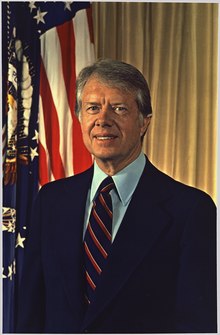
James Earl "Jimmy" Carter - NARA - 558522.tif

James Earl "Jimmy" Carter Jr. (born October 1, 1924) is an American politician who served as the 39th President of the United States from 1977 to 1981. In 2002, he was awarded the Nobel Peace Prize for his work with the Carter Center.

Carter, a Democrat raised in rural Georgia, was a peanut farmer who served two terms as a Georgia State Senator, from 1963 to 1967, and one as the Governor of Georgia, from 1971 to 1975. He was elected President in 1976, defeating incumbent President Gerald Ford in a relatively close election; the Electoral College margin of 57 votes was the closest at that time since 1916.

On his second day in office, Carter pardoned all evaders of the Vietnam War drafts. During Carter's term as President, two new cabinet-level departments, the Department of Energy and the Department of Education, were established. He established a national energy policy that included conservation, price control, and new technology. In foreign affairs, Carter pursued the Camp David Accords, the Panama Canal Treaties, the second round of Strategic Arms Limitation Talks (SALT II), and the return of the Panama Canal Zone to Panama. On the economic front he confronted persistent "stagflation", a combination of high inflation, high unemployment and slow growth. The end of his presidential tenure was marked by the 1979–1981 Iran hostage crisis, the 1979 energy crisis, the Three Mile Island nuclear accident, and the Soviet invasion of Afghanistan. In response to the Soviet move he ended détente, escalated the Cold War, and led the international boycott of the 1980 Summer Olympics in Moscow. By 1980, Carter's popularity had eroded such that, running for re-election that year, he was challenged by Senator Ted Kennedy in the Democratic Party's primaries for the presidential nomination, marking the most recent Democratic primary in which an incumbent faced serious opposition. Carter won the 1980 primary with 51.13% of the vote (all incumbent candidates since have won at least 72.8% of their party's primary votes) but lost the general election in an electoral landslide to Republican nominee Ronald Reagan, who won 44 of 50 states.

His presidency has drawn medium-low responses from historians, with many considering him to have brought greater accomplishment with his post-presidency work. He set up the Carter Center in 1982 as his base for advancing human rights. He has also traveled extensively to conduct peace negotiations, observe elections, and advance disease prevention and eradication in developing nations. Additionally, Carter is a key figure in the Habitat for Humanity project. He has been the longest-retired president in American history since September 2012, when he surpassed Herbert Hoover. He is also the first president to mark the 40th anniversary of his election and inauguration.

Regarding current political views, he has criticized some of Israel's actions and policies in regards to the Israeli–Palestinian conflict and has advocated for a two-state solution. He has vigorously opposed the Supreme Court's decision in Citizens United v. FEC to strike down McCain-Feingold limits on campaign spending by corporations and unions, saying that the U.S. is "no longer a functioning democracy" and now has a system of "unlimited political bribery." He supported former President Barack Obama during his time in office but was critical of aspects of his foreign policy, particularly with regard to the use of drones and Obama's failure to close Guantanamo Bay detention camp.

Ronald Reagan

5.Ronald Reagan

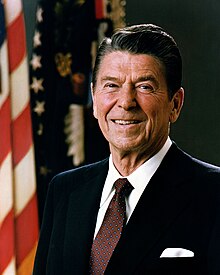
Official Portrait of President Reagan 1981.jpg

Ronald Wilson Reagan (/ˈrɒnəld ˈwɪlsən ˈreɪɡən/; February 6, 1911 – June 5, 2004) was an American politician and actor who was the 40th President of the United States, from 1981 to 1989. Before his presidency, he was the 33rd Governor of California, from 1967 to 1975, after a career as a Hollywood actor and union leader.

Raised in a poor family in small towns of northern Illinois, Reagan graduated from Eureka College in 1932 and worked as a sports announcer on several regional radio stations. After moving to Hollywood in 1937, he became an actor and starred in a few major productions. Reagan was twice elected President of the Screen Actors Guild, the labor union for actors, where he worked to root out Communist influence. In the 1950s, he moved into television and was a motivational speaker at General Electric factories. Having been a lifelong Democrat, his views changed. He became a conservative and in 1962 switched to the Republican Party. In 1964, Reagan's speech, "A Time for Choosing", in support of Barry Goldwater's foundering presidential campaign, earned him national attention as a new conservative spokesman. Building a network of supporters, he was elected Governor of California in 1966. As governor, Reagan raised taxes, turned a state budget deficit to a surplus, challenged the protesters at the University of California, ordered National Guard troops in during a period of protest movements in 1969, and was re-elected in 1970. He twice ran unsuccessfully for the Republican nomination for the U.S. presidency in 1968 and 1976; four years later, he easily won the nomination outright, becoming the oldest elected U.S. president up to that time, defeating incumbent Jimmy Carter in 1980.

Entering the presidency in 1981, Reagan implemented sweeping new political and economic initiatives. His supply-side economic policies, dubbed "Reaganomics", advocated tax rate reduction to spur economic growth, control of the money supply to curb inflation, economic deregulation, and reduction in government spending. In his first term he survived an assassination attempt, spurred the War on Drugs, and fought public sector labor. Over his two terms, the economy saw a reduction of inflation from 12.5% to 4.4%, and an average annual growth of real GDP of 3.4; while Reagan did enact cuts in domestic discretionary spending, tax cuts and increased military spending contributed to increased federal outlays overall, even after adjustment for inflation. During his re-election bid, Reagan campaigned on the notion that it was "Morning in America", winning a landslide in 1984 with the largest electoral college victory in history. Foreign affairs dominated his second term, including ending of the Cold War, the bombing of Libya, and the Iran–Contra affair. Publicly describing the Soviet Union as an "evil empire", and during his famous speech at the Brandenburg Gate, President Reagan challenged Gorbachev to "tear down this wall!". He transitioned Cold War policy from détente to rollback, by escalating an arms race with the USSR while engaging in talks with Soviet General Secretary Mikhail Gorbachev, which culminated in the INF Treaty, shrinking both countries' nuclear arsenals.[1] Reagan's presidency came during the decline of the Soviet Union and just ten months after the end of his term, the Berlin Wall fell, and on December 26, 1991, nearly three years after he left office, the Soviet Union collapsed.

Leaving office in 1989, Reagan held an approval rating of sixty-eight percent, matching those of Franklin D. Roosevelt, and later Bill Clinton, as the highest ratings for departing presidents in the modern era.[2] He was the first president since Dwight D. Eisenhower to serve two full terms, after a succession of five prior presidents failed to do so. While having planned an active post-presidency, in 1994 Reagan disclosed his diagnosis with Alzheimer's disease earlier that year, appearing publicly for the last time at the funeral of Richard Nixon; he died ten years later in 2004 at the age of 93. An icon among Republicans, he is viewed favorably in historian rankings of U.S. presidents, and his tenure constituted a realignment toward conservative policies in the U.S.

George H. W. Bush

4. George H. W. Bush


George H. W. Bush, President of the United States, 1989 official portrait.jpg

George Herbert Walker Bush (born June 12, 1924) is an American politician who was the 41st President of the United States from 1989 to 1993 and the 43rd Vice President of the United States from 1981 to 1989. A member of the U.S. Republican Party, he was previously a congressman, ambassador, and Director of Central Intelligence. He is the oldest living former President and Vice President. Since 2000, Bush has often been referred to as "George H. W. Bush", "Bush 41", "Bush the Elder", or "George Bush Senior" to distinguish him from his eldest son, George W. Bush, who became the 43rd President of the United States. Prior to his son's presidency, he was simply referred to as George Bush or President Bush.

Bush was born in Milton, Massachusetts, to Prescott Bush and Dorothy Walker Bush. Following the attack on Pearl Harbor in 1941, Bush postponed his university studies, enlisted in the U.S. Navy on his 18th birthday, and became the youngest aviator in the U.S. Navy at the time.[1][2] He served until the end of the war, then attended Yale University. Graduating in 1948, he moved his family to West Texas and entered the oil business, becoming a millionaire by the age of 40.

Bush became involved in politics soon after founding his own oil company, serving as a member of the House of Representatives and Director of Central Intelligence, among other positions. He failed to win the Republican nomination for President in 1980, but was chosen as a running mate by party nominee Ronald Reagan, and the two were elected. During his tenure, Bush headed administration task forces on deregulation and fighting the "War on Drugs".

In 1988, Bush ran a successful campaign to succeed Reagan as President, defeating Democratic opponent Michael Dukakis. Foreign policy drove the Bush presidency: military operations were conducted in Panama and the Persian Gulf; the Berlin Wall fell in 1989, and the Soviet Union dissolved two years later. Domestically, Bush reneged on a 1988 campaign promise and, after a struggle with Congress, signed an increase in taxes that Congress had passed. In the wake of a weak recovery from an economic recession, along with continuing budget deficits and the controversy over his appointment of Clarence Thomas to the Supreme Court, he lost the 1992 presidential election to Democrat Bill Clinton.

Bush left office in 1993. His presidential library was dedicated in 1997, and he has been active—often alongside Bill Clinton—in various humanitarian activities. Besides being the 43rd president (2001–09), his son George also served as the 46th Governor of Texas (1995–2000) and is one of only two presidents—the other being John Quincy Adams—to be the son of a former president. His second son, Jeb Bush, served as the 43rd Governor of Florida (1999–2007) and made an unsuccessful run for the Republican Party nomination for the office in 2016.